Monday, December 28, 2009

Standard Operating Procedure 13

photo by cm0rris0nWhile in our nortwestern states, the gray wolf fights for survival, a little-known subspecies, the Mexican Gray Wolf, fights a very desperate battle. As far as we know, there are only 52 Mexican Gray Wolves left in the wild.

There has been a re-introduction plan to help the species survive. But at the same time there was Standard Operating Procedure #13, which dictated that any wolf that is accused of killing any livestock three times must be shot.

Two and a half years ago, Alpha Female 924, one of only 3 breeding females in the entire Mexican Gray Wolf population, reached her third strike, and was killed.

Fortunately, outrage over that killing led to a change in procedure. Last month, the U.S. Fish and Wildlife Service took control and ruled that SOP13 will not be in force in the future.

The U.S. Fish and Wildlife Service is also coming up with new programs to help local ranchers to coexist with the wolves.

Alpha Male 923 and the pair's four offspring could not be reached for comment.

But this is definitely a step in the right direction.

More information can be found at BiologicalDiversity.org and the Washington Post, which also has a beautiful picture of a Mexican Gray Wolf.

Thursday, December 24, 2009

Merry Christmas!

Here's a couple of videos for Christmas. Happy animals! I hope your Christmas is happy as well.


If you're reading this on Facebook, click here.

Thursday, December 03, 2009

Playtime!

There's probably a couple of things going on here that the cats like. I know that a couple of my cats really enjoy smooth textures; one goes for shiny hard plastic, another for nylon fabric. They'll just sit and paw at it, claws out, but their claws have no traction, and they enjoy the sensation very much.

In this video, the kittens have a huge amount of smooth plastic they can go at with all four feet. The smooth surface plus the challenge of beating gravity probably add up to one of the best cat play areas ever.

And it's just a darn cute video. This is the full unedited version, not tricked up with unnecessary cuts or repeats.

Monday, November 30, 2009

The Dark Side

My goal in writing this blog is to inform anyone I can about the intelligence and loving nature of the animals whose societies surround us everywhere. I want to be positive and uplifting.

Sometimes I can't help but look at the dark side. I rail against such blind myths as "wild" and "domesticated" and the damage they do to our perceptions of animals, but I try to balance that by showing what really paying attention and truly observing animals can reveal.

Sometimes the dark side overwhelms me. Tigers are being killed to extinction because of the crazy belief in magic--tiger penises are supposed to have mad crazy aphrodisiac powers. This is a closed circle of insane beliefs, because if you believe something will have an effect on you, in an aspect that is largely psychologically-controlled, then it will. The tiger has no magical powers, but it is the victim of a self-perpetuating circle of insanity.

And my current trip into the dark side is the result of a similar story in the news about belief in "magic" in Africa: Albino people are supposed to bring disaster wherever they go, but a dead albino person can be carved up and sold for $75,000 because their body parts are believed to have magical powers. So these people have little refuge while alive and plenty of people trying to kill them. All because of unexamined, insane myths.

But if people are willing to do that to other people in their own towns, how can I hope that people will ever examine and discard their myths about other species?

OK... I'm sorry. I promise to return soon with a more uplifting post.

Wednesday, November 18, 2009

Playing with a Polar Bear

Polar bears have a bad reputation. Everybody knows they are one of the most fearsome species on earth. So what happens when a hungry polar bear comes across some Husky dogs that are chained up and can't run away?


This story is on YouTube in several different versions, but I think the one above is the best, simply showing what happened without a lot of extraneous nonsense.

Saturday, November 14, 2009

Wednesday, November 11, 2009

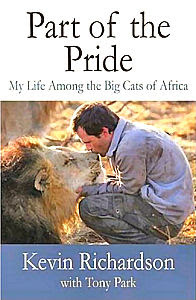
Part of the Pride

Part of the PrideKevin Richardson has a new book out now called Part of the Pride, a memoir in which he tells how he came to be "The Lion Whisperer".

Here's a short quote from early in the book, when Richardson was just being introduced to the lions at the Lion Park:
...We came to another enclosure containing two older cubs. At 6 or 7 months, they had reached an age where they could no longer be petted by visitors to the park, and they were big--much bigger than I had expected. One was called Napoleon and the other, which had yet to be christened, had the most incredible clear eyes.

Conventional wisdom--or perhaps superstition--among lion keepers, I later learned, was that one should never trust a lion with clear eyes. Like a lot of things people told me about lions over the years to come, and like conventional wisdom in general, that little gem turned out to be bullshit.
Oh, yes -- I'm going to like this book.

Here are some other rules about lions that Richardson was told:
  • Don't look them in the eye.
  • Don't turn your back on them.
  • Don't crouch or kneel or they will climb up on your back.
  • Don't run.
  • Don't make any sudden movements.
  • Don't scream. Talk quietly.
I can tell you right off that "don't look them in the eye" is bullshit. Every captive lion or tiger I've seen--that hasn't had his spirit broken or hasn't given up trying to make contact with humans--wants you to look them in the eye. They want you to recognize that there is a person in that fur. That sort of contact is the solid foundation of a good relationship with the animal.

Besides, lions, like cats, use the 'slow blink' as a means of letting you know everything is cool with them. You can't exchange this signal if you don't look them in the eye.

As for never crouching in the presence of a lion, click here to read what I learned from a very endearing lion.

I was so glad to see Richardson dismiss silly "conventional wisdom" as bullshit. So much of it is. He has learned through first hand experience how to treat animals, and he has been rewarded with some of the most wonderful animal friendships, even with animals others wouldn't go near.

I will definitely be reporting more from this book. Below is a short video of Kevin Richardson with some of his animals.

Thursday, November 05, 2009

Words vs. Thinking

I haven't posted for a while; part of the reason was the flu, the other part is that I've gotten bogged down in other people's words while trying to research new articles. I'll try to break free by limiting my own words in this new post.

Bog 1: Tom Regan spends a lot of time philosophizing in his The Case for Animal Rights, but too many words can serve to hide the truth more than examine it. And if he can say that humans have a higher life quality than any other animal, he must not realize that such a statement is only a little bit different than Descartes' "biological machines" view of animals.

Bog 2: Some scientists do recognize that animals have societies and cultures of their own. But they're afraid of going all the way with this idea. That leads to a lot of roundabout language. Still, this article is interesting, about male dolphins bringing a bouquet to a prospective mate: Dolphins Use Weeds to Get Girls.

And here's an earlier article about whale culture: Culture Shock

There. I hope that ends my writer's block.

Tuesday, October 27, 2009

Advances in Language Study

Often I am reminded of the damage being done to people's awareness by some of our colleges and universities. Ridiculous ideas like, animals are mere biological machines (Descartes), animals' actions are merely conditioned reflexes (Skinner), and language appears to be a uniquely human phenomenon, without significant analogue in the animal world (Chomsky) are religiously clung to and promoted, in spite of the overwhelming evidence to the contrary available to any true observer.

Fortunately, there are people who are willing to observe and learn.

starlingA study of starlings, led by Timothy Gentner of the University of California (San Diego), shows that these birds not only have a language of their own, this language includes complicated sentence structure. Although the scientists did not actually decipher the birds' language, they created an artificual grammar from recorded starling songs and found that the birds were able to understand what is called recursive sentence structure, such as changing "the bird sang" to "the bird the cat chased sang".

From the article on the UCSD web site:
Gentner says, "The more closely we understand what nonhuman animals are capable of, the richer our world becomes. Fifty years ago, it was taboo to even talk about animal cognition. Now, there are [TV shows] on the subject and no one doubts that animals have complex and vibrant mental lives. This study is a powerful statement about what even birds can do: Look at what they’re learning."
I'm glad that Gentner can believe that "no one doubts" these things. I wish that philosophy were true in all schools.

Sunday, October 18, 2009

Cruel to be Kind?

In today's New York Daily News, Stephen Budiansky writes that when people pamper their dogs, they don't necessarily give the dogs what they really need to be happy.

And, just like when I read Budiansky's book "If a Lion Could Talk", I think he has a point, but he goes about making that point in the wrong way.

In today's article, he ridicules such things as doggie day care centers, designer pet foods, and people who refer to themselves as "pet parents".

While I would agree that there are plenty of useless (or worse) excesses for people to waste their money on, I would like to give the "pet parents" the benefit of the doubt and hope that they actually want what's best for their dog. What they need is education along that line, not ridicule. Reducing such education to a glib line like 'you must be crueler to be kind' is not helpful or even correct.

Budiansky argues that a dog needs to know its proper place in the family structure. Of course, this is true. It's true for any animal (or human) that has a relationship with any other animal (or human). A clear idea of one's role in any society, no matter how microcosmic, is of key importance to one's psychological well-being.

That Budiansky credits this need to a mythical wolf-social-structure gene that 'all dogs still carry' is a red herring and gets in the way of the education all animal "parents" need. Any decent tiger handler will tell you pretty much the same thing I said in the previous paragraph; that you need to establish for the tiger what the family or society structure is, for the well-being of all involved. And I defy anyone to find the "wolf-social-structure" gene in a tiger.

What I'm saying is that Budiansky needs to leave the ridicule and false science behind and concentrate on the education that dog owners (and all animal owners) need: your animal needs to have a clear picture of his role in your family. The entire value of Budiansky's article is found in the last paragraph. You have to be firm; you have to be consistent; you have to take on the role of a true parent. You have to pay attention to your animal. There is nothing "cruel" about any of this. It's what any social animal needs to be happy and a good family member.